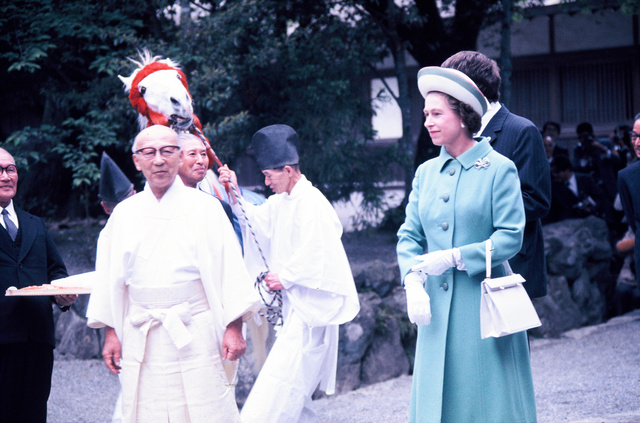
Photo 1: On May 11, 1975, Queen Elizabeth of the United Kingdom visited the Inner Shrine of Ise Grand Shrine. On the left, Chief Priest Muneyoshi Tokugawa can be seen.
Tokugawa Muneyoshi was born in 1897 (Meiji 30) as the second son of the 12th head of the Mito branch of the Tokugawa family, and was later adopted into the Hitotsubashi branch of the Tokugawa clan. In 1920 (Taishō 9), he married Motoko, granddaughter of Tokugawa Yoshinobu, the last shogun of the Edo bakufu. Having graduated from the Department of Forestry in the Faculty of Agriculture at the University of Tokyo, Muneyoshi traveled to Europe in 1926 (Taishō 15) accompanied by his wife. During their two-and-a-half-year sojourn abroad, they were exposed to the cultures of advanced nations, while also witnessing firsthand the decline of the nobility in Germany and Austria, who had lost social standing and wealth as a result of their countries’ defeat in the First World War. In the aftermath of the Second World War, Muneyoshi served as the last Vice President of the House of Peers, and in 1951 (Shōwa 26) he was appointed plenipotentiary to the San Francisco Peace Conference. He also held the post of High Priest of the Grand Shrine of Ise. Dedicating himself to nationwide afforestation campaigns, he was later acclaimed as the “Father of Greening.” (Recorded by Kaoru Miura) He passed away at the age of ninety-one in 1989. (May 31, 1897 – May 1, 1989)
古賀忠道 Koga, Tadamichi
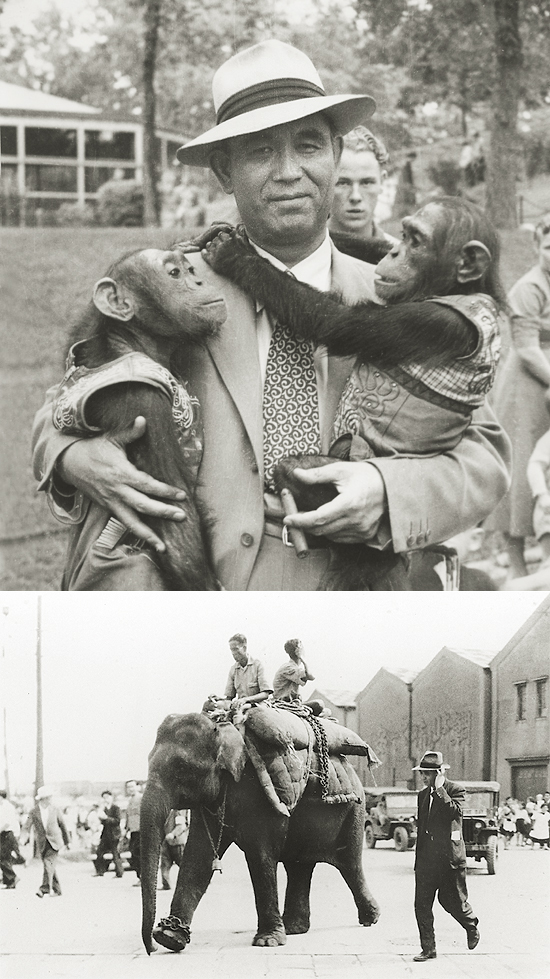
Photo 2 (top), Photo 3 (bottom)
写真上:欧米視察,チンパンジーと(1951年)
写真下;日本に到着し、上野動物園に向かうインディラと古賀忠道園長(1949年、芝浦埠頭)
Photo 2 (1951): Inspection tour of Europe and America,holding chimpanzees. Photo 3 (Shiba’ura Pier, 1949) : Indira and Director Tadamichi Koga heading to Ueno Zoo upon arrival in Japan.
Tadamichi Koga was born in Saga Prefecture on December 4, 1903 (Meiji 36). In 1928 (Showa 3), upon graduating from the Department of Veterinary Medicine, Faculty of Agriculture, Tokyo Imperial University, he entered the Tokyo City Park Section and began his career at Ueno Zoological Gardens. In 1936 (Showa 11), following the incident of a black panther’s escape, the absence of a formal directorship at the zoo was reconsidered. Consequently, on March 1, 1937, the office of “Director” was established, and he was formally appointed as the first Director of Ueno Zoological Gardens. After World War II, in 1946 (Showa 21), he oversaw the opening of the “Kamoshika-za” cinema. In 1948, he initiated the founding of the Children’s Zoo, and soon after, the launch of the “Monkey Train,” dedicating his efforts to delivering cheerful experiences for children. In 1949 (Showa 24), Prime Minister Jawaharlal Nehru of India presented the Asian elephant Indira to Japan (see Photo 3). In 1950, a traveling zoo was organized with Indira as its centerpiece. (Photo 2 shows him on his inspection tour of Europe and the United States the following year.) In 1962 (Showa 37), after the celebration of the zoo’s 80th anniversary, he retired from his directorship. Following retirement, he became Chairman of the Tokyo Zoological Park Society and also served as Chairman of the Japan Committee of the International Union for Conservation of Nature (IUCN). He further devoted himself to the establishment of the World Wildlife Fund (WWF) Japan Committee. He passed away in 1986 at the age of eighty-two (December 4, 1903 – April 25, 1986). (Excerpted and slightly edited from the remarks contributed by Ueno Zoo Director Hiroshi Sugaya, 2003.)
Masa’aki Uyeda served as the chief priest of Obata Shrine, the tutelary shrine where Onisaburō Deguchi, one of two Founders of Ōmoto-kyō, experienced his divine inspiration. My father, Tsugimori Koba, trusted him for his scholarly integrity. It was through Tsugimori’s arrangement that Fumiko and me held our wedding ceremony at Obata Shrine, officiated by Reverend Masa’aki Uyeda. Unfortunately, there are no good photographs available online; however, during the ceremony Tsugimori took many pictures, which will surely be found if I search through my album. The following is a citation from the introduction provided upon his receipt of the Fukuoka Asian Culture Prize in 1998. The original text contained considerable repetition, which has here been reduced for clarity. Masa’aki Uyeda illuminated the history of ancient Japan in the broader context of East Asian historical developments. His achievement lay in constructing a new historical perspective—Japan within Asia—for which he has received international acclaim. In his work “Considering the Myths of Japan”,『日本の神話を考える』, he pursued comparative studies of Japanese mythology alongside those of China and the Korean Peninsula. Through interdisciplinary research that integrated history, folklore, and archaeology, he explored the formation and character of Japanese myths. He emphasized the significance of cultural influences from the Chinese continent and the Korean Peninsula, as well as the role of maritime routes linking Japan with the wider Asia-Pacific. From this perspective, he constructed an entirely new regional history in which Japan is situated as part of Asia. In 1990, he founded the Society of Asian Studies, the first international academic association devoted to East Asian antiquity. At its sixth meeting, held in Beijing in 1996, he was appointed as president. He passed away in 2016 at the age of eighty-eight. Born on April 29, 1927, in Kinosaki, Hyōgo Prefecture, he entered the Specialized Division of Kokugaku’in University during the war years in order to prepare for succession to the priesthood of Obata Shrine, into which he had been adopted. There he studied under such scholars as Shinobu Orikuchi. After the war, he advanced to the Faculty of Letters at Kyoto University.
Young guest from Belgique
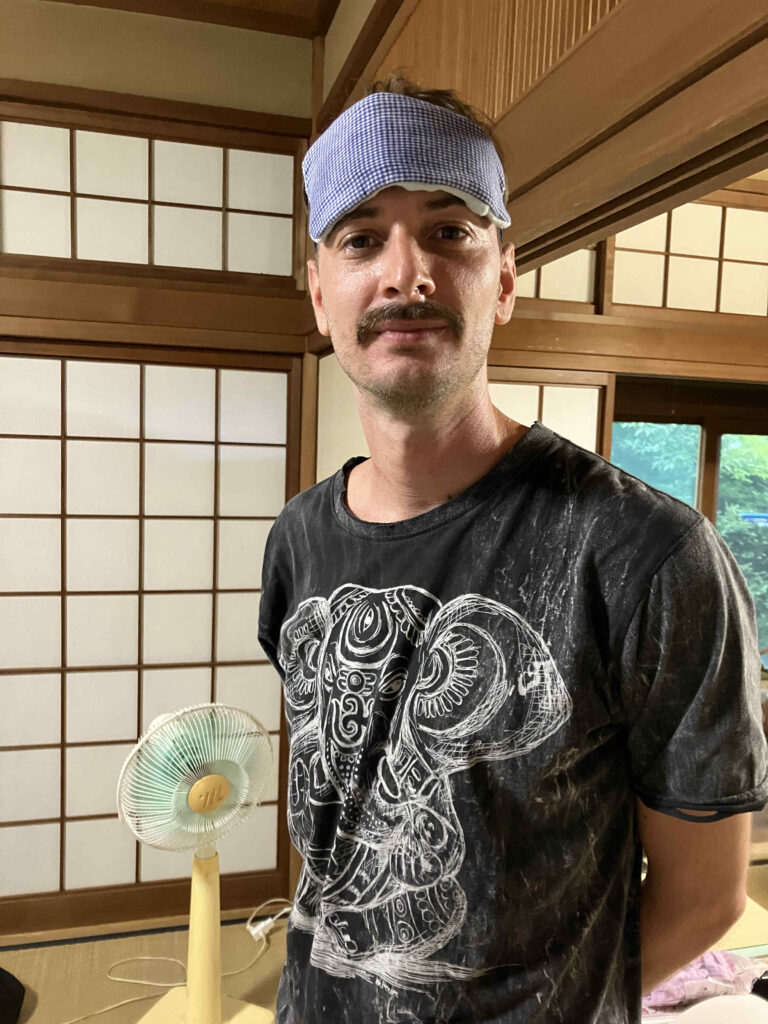
Photo 4 Kevin from Belgique
The young man in Photo 4 is a researcher from Belgium. He mainly observes the realities of religion in various Southeast Asian countries. He was brought here by my niece. His specialties are psychology and philosophy. The thing on his head is an ice pack that I gave him. It was really hot Yesterday, but being at the foot of the mountain meant we sometimes got a cool breeze—along with the mosquitoes. He’s a genuinely nice guy with good character.
まずは長いロープを切らずに使うのに,縮め結び sheepshank があるが,これは上記 Animated Notchでは,The Sheepshank Knot should be avoided! とある。日本語のサイトでも強い引きには耐えられないというような記述がある。”The Alpine Butterfly Loop is the best replacement for a Sheepshank. It’s a knot used to take up the slack on a line or isolate a worn section of a rope. This knot can be used to shorten a length of rope too.”
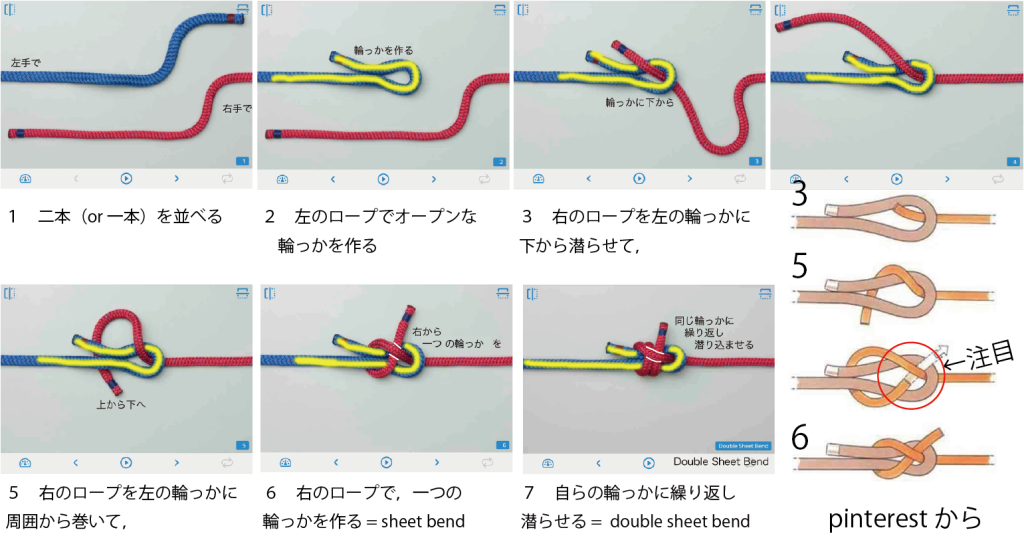
図3左手上図の支え杭にロープを固定するのであるが,そのノットとして,sheet bend 一重繋ぎを選んだ(二種のロープを繋ぐ場合,太い方は青色のロープに対応する)。このノットは,ヨットの帆を繋ぐために使われてきたものである。なお,sheetは帆船の一部のロープを言う。図4の7コマの図は,Animated Knots が提供する Sheet Bend: Joins two ropes of unequal, or similar, size から拝借し,テキストや線を追加したものである。図4の右下のものは,Pinterestに掲載されていたもので,図中の3,5,6は7コマに付した番号と対応している。
Microsoft WordファイルをPages for iCloudで編集してみる editing a Pages file converted from a Microsoft Word file in Pages for iCloud
はじめに
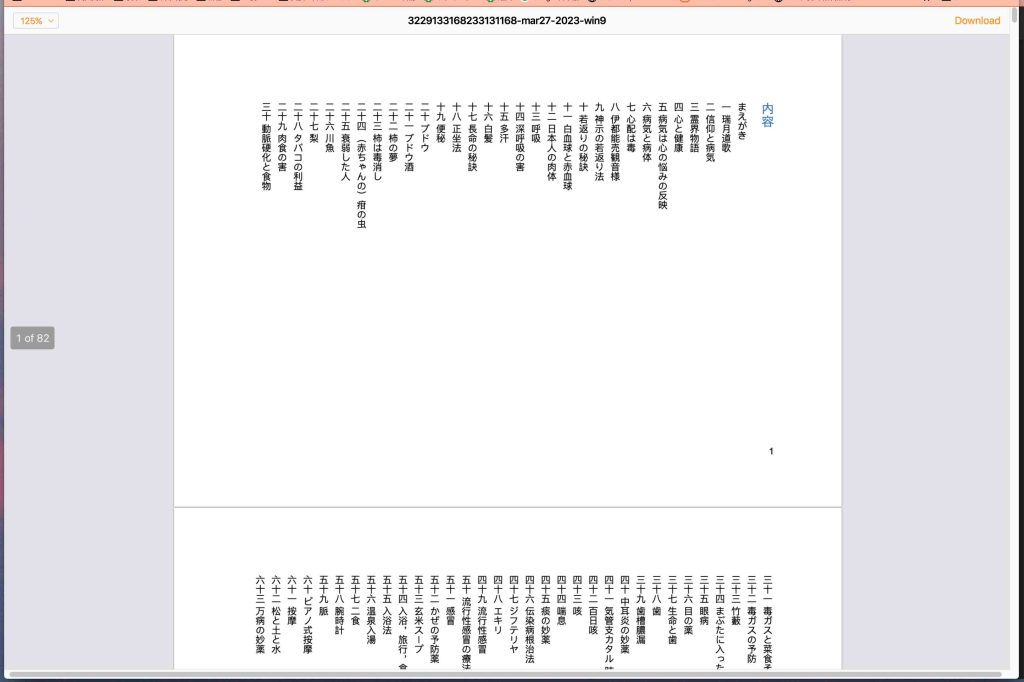
Microsoft Wordで作成したファイルの内容が,Pagesではどの程度,再現されるのか,確かめたいと思う。このMicrosoft Wordファイルには,150余りの脚注,350ほどの索引があり,いずれもハイパーリンクがセットされている。このポスティングは,Apple Booksへの投稿の可能性 の作成過程で思いついたテーマである。
1 Microsoft WordファイルをPages for iCloud で開く
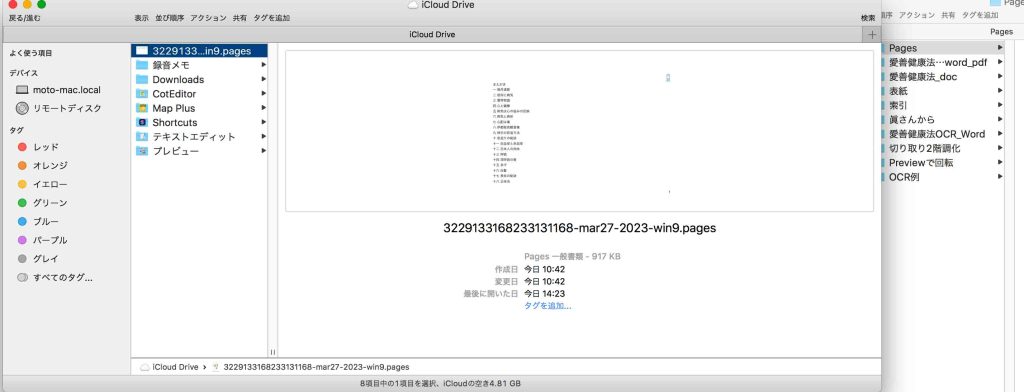
ボクのmacOS sierra (10.12)ではPagesが使えない。iPadでは使えるが触る気がしない。ネット検索すると,PagesファイルからMicrosoft Wordファイルを作成する需要がたかく,Microsoft WordファイルからPagesファイルを作成するというコンテンツはこの二日ほどみて,見つからなかったが,昨晩2時頃見つけて,今朝,変換した。それをこれから,見てみることに。期待はあんまり期待していないが,楽しみではある。
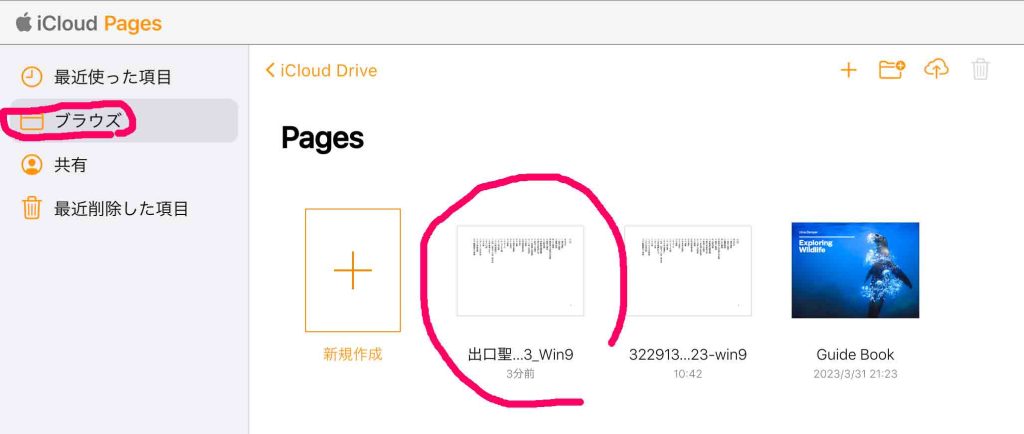
図10には,Microsoft WordファイルそのものをファインダーでiCloud Driveに入れて,iCloudのブラウザー表示して,Pagesフォルダに移動してタップすると,Pages for iCloudが立ち上がって,やはり,図6のアラートが出る。
ひょっとするととコンバーター無しで,やってみた。変換済みPagesファイルと同じ過程でファイルをドラッグアンドドロップして,図10のMicrosoft Wordファイルを立ち上げても,Pages for iCloudがファイル変換してくれて表示できた。その結果はPagesファイルの時と全く同じものであった。リンクはすべて切れていた。onlineconverterfree.comのコンバーターには問題はなく,Pagesの限界だ。